Essays on Woman
Reading Edith Stein's Essays on Woman
This fall I’m co-leading a reading group on Edith Stein, primarily her Essays on Woman, which is a collection of talks she gave in the 1930s around central Europe on the topic of woman. I use the verb “leading” generously, for I am in the group with Stein scholars and sitting at their feet, asking all the questions that I can.
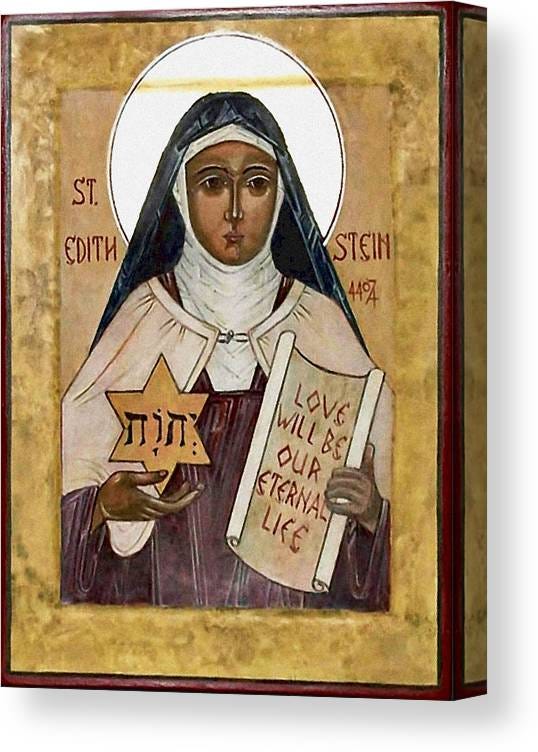
I first heard about Edith Stein at the 2004 Calvin Festival of Faith and Writing when the theater group there produced a play about her arrest and death in the concentration camps. Her life story is inspiring, a narrative written by her Creator. Born into a Jewish family on Oct 12, 1891 (we just celebrated her birthday this month), Stein was the youngest of 11 children. Now that she has been canonized, the facts of her life are reinterpreted as signs of her future holiness. For instance, she was born during Yom Kippur, the Feast of Atonement.
Stein was a philosopher, a student of Edmund Husserl. When she finished her doctorate, women were not permitted to become professors (they had only recently been allowed into colleges in Germany and were still barred from degrees in Britain). Yet Husserl wrote her a recommendation letter with a backhanded compliment, “Should academic careers be opened up to ladies, then I can recommend her whole-heartedly….” Instead, Stein taught secondary school, gained a reputation as a public speaker, and eventually became a Carmelite nun.
Her conversion to Christianity occurred when she read St. Teresa of Avila’s autobiography. She closed the book and announced, “This is the truth.” Later she studied Thomas Aquinas, translating his De Veritate, and wrote theological treatises, such as Finite and Eternal Being, The Science of the Cross, and Ways to Know God. When she entered the convent, Stein took the name Sister Teresa Benedicta a Cruce, explaining, “I understood the cross as the destiny of God’s people.” On August 2, 1942 Stein was arrested by the Gestapo, along with her sister Rose, and deported to Auschwitz. Stein envisioned herself as a second Esther—though a “small one”—willing to die for her people. She was likely executed on August 9. In 1998 the Roman Catholic Church canonized her as a saint.
The essays on woman were published more than fifty years after they were written, and although they sound antiquated to our contemporary ears, many of her thoughts on women were liberal for her time and eternally true. Around the same time that Stein was being considered for sainthood, Pope John Paul II put out an encyclical Evangelium Vitae (1995) that called for a “new feminism,” echoing Stein’s claims about women. Perhaps a reconsideration of Stein’s arguments would aid us in our search for Christian feminism: one that recognizes the uniqueness of women, their equal standing in the mystical body of Christ, without being mistakenly tangled up with sexual license or misandry.
For Stein, women have a special vocation as spouses and mothers, though she does not limit these categories to biology. Rather, she interprets women’s roles spiritually—we are spouses of Christ and maternal to all our neighbors. “Woman naturally seeks to embrace that which is living, personal, and whole. To cherish, guard, protect, nourish and advance growth is her natural, maternal yearning.” Stein herself was a bride of Christ, and therefore, not a biological mother. If women look to the Virgin Mary, they will see the exemplar for the female sex: “The image of the Mother of God demonstrates the basic spiritual attitude which corresponds to woman’s natural vocation.”
I agree with Stein both that women’s uniqueness lies in our capacity as mothers and that the Virgin Mary is our paragon. However, I do not interpret “spouse” the way that she does, nor do I see Mary as relating to her husband with “obedience, trust, and participation in his life as she furthers his objective tasks and personality development.” Rather, Joseph participates in the objectives that God has called Mary to carry out, not vice versa. When I have written on Mary, I focused on her prophecy and poetry in the Magnificat.
Stein is progressive for her era in recognizing the good of women working outside the home, playing a part in the national life, and having “masculine characteristics” sometimes “just as many men share feminine ones.” Yet some of her claims about women seem to stem from cultural assumptions more than revelation. Often Stein will insist that a woman possesses a special gift, such as a stronger union with her soul than man, that I find unsubstantiated. And I find myself wondering what Stein would make of certain passages of Scripture where Jesus or Paul refer to themselves figuratively as mothers (Matt 23:37-39, Gal 4:19, 1 Thes 2:7-8).
In this current hostile climate where people are battling out the definition and meaning of “Woman,” reading Stein is refreshing. Because she argues so brilliantly on the nature of women, her seemingly outmoded statements about women will make us reconsider why we disagree before we cross anything out. She insists that women are individuals with a variety of ways of being in the world. “Indeed, no woman is only woman; like man, each has her individual speciality and talent.” We can be Judith, Esther, Joan of Arc, or Edith Stein.
*I’d tried for “Assays” as a play on “Essays” in my title previously, but it was too confusing. And if you have to explain your joke, it flopped.
Current Writers of New Feminism
If this topic interests you, there are a handful of writers (both Catholic and Protestant) whom I admire on feminism from a Christian perspective.
Erika Bachiochi: A guest on the Ezra Klein show, author of The Rights of Women, and a Senior Fellow at the Abigail Adams Institute
Beth Allison Barr: Bestselling author of The Making of Biblical Womanhood
Abigail Favale: Check out The Genesis of Gender and our YouTube on Herland
Wilda Gafney: While I do not endorse all of her stances, Gafney writes some illuminating things about women in the Old Testament.
Kristin Kobes Du Mez: Known for her bestselling Jesus and John Wayne, Kristin introduced me to Kate Bushnell, whose God’s Word for Women is eye-opening!
Beth Felker Jones: Read her substack “The Bible and the end of patriarchy”
Laura Robinson: Another substack recommendation
Leah Libresco Sargeant: And, Other Feminisms
Michele Schumacher: We’ve never met, but I was prodded by her book Woman in Christ: Toward a New Feminism to ask more questions of this topic.
Worthy and Jesus & Gender by Elyse Fitzpatrick and Eric Schumacher; they also have a podcast on this topic
As I’ve mentioned before, I am researching for a book on Dorothy L. Sayers, Edith Stein, and Anna Julia Cooper right now. I appreciate all your questions, suggestions, or book recommendations.
“God created humanity as man and woman, and He created both according to His own image. Only the purely developed masculine and feminine nature can yield the highest attainable likeness to God” —St. Edith Stein
Notable Links
The Flannery O’Connor biopic didn’t get a rave review from The Guardian. I’m still pausing on my judgment until I can see it. But I did write up a preliminary article with my hopes for the film in the Washington Examiner.
DANIEL NAYERI, BETH MOORE, & ESAU MCCAULLEY at Wheaton speaking about faith and memoir. That should be enough information for you to want to click immediately on the recording and watch it! One of the best conversations that I’ve heard in a long time. I found myself listening on my walk and then turning it off to pray.
Season 3 of the Scandal of Reading podcast, hosted by Christ and Pop Culture with co-hosts Austin Carty and Claude Atcho. This season’s line up is going to be great: Shemaiah Gonzales, Phillip Yancey, Grace Hamman, Russell Moore, Winn Collier, and others on Julian of Norwich, Christian Wiman, John Donne, and more!
I talked with the guys on Faithful Politics about Reading for the Love of God. We discuss reading, AI, and ChatGPT creates a haiku about me and Flannery.
Our book The Liberating Arts recently launched! Go back and check out all the inspiring content on our website about the work of scholars and artists who promote liberal education.
What I read this month
I gave up on Humanely Possible with only a few chapters left because the rhetoric against Christianity grew too nonsensical for me. I jumped into How Far to the Promised Land and have no regrets—a WAY better book.
And I’m not just saying that because he endorsed my upcoming book!


Thanks, I recently finished a course on Edith Stein and am reading her life story and plan to read the essays. I also recently completed a Catholic certification in a program designed to teach mothers to teach their daughters about cycle awareness, called Cherry Blossom Buds. The theology of the course is based on Evangelium Vitae. It wasn't until learning about Edith Stein that I realized this document was influenced by her work. The reading group sounds interesting. I would like to join and went to the site but didn't see the link. Perhaps it is full or already in progress. Thanks again for sharing!
I had no idea Edith Stein’s life ended in a concentration camp:/